
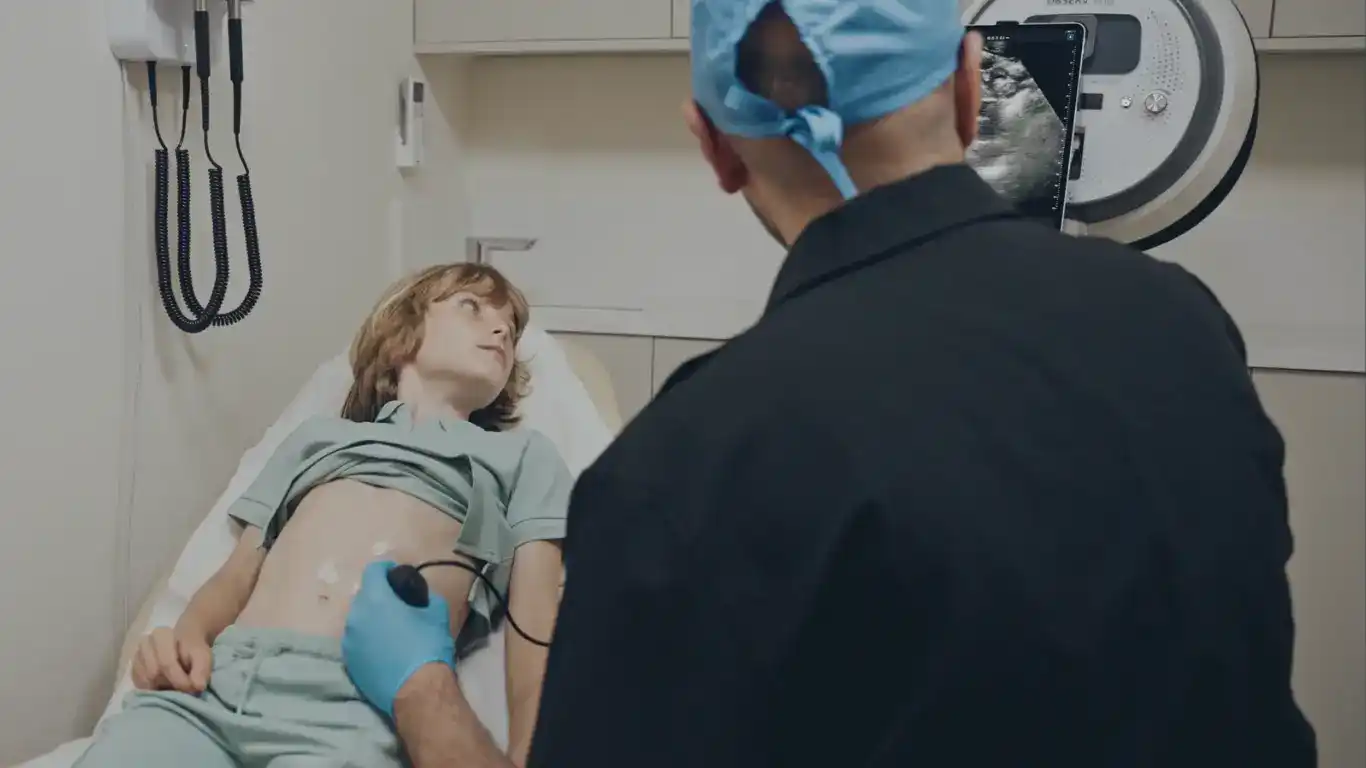
Ultrasound-guided procedures at Taylor Grey
Private Ultrasound-Guided Injections in Knightsbridge, London
Procedures we perform
Every injection is performed by Dr Batou Ahmed Belhadj, Consultant Musculoskeletal Radiologist, under real-time ultrasound guidance.
Book Now
Phone: 020 8050 0777
Email: info@taylorgrey.com
Joint, tendon and nerve pain that has not settled with rest and physiotherapy can often be helped by a precisely placed injection. At Taylor Grey the consultant who scans you also treats you, watching the needle on screen from skin to target, and usually in the same visit as your diagnostic MSK ultrasound.
Joint steroid injections
A corticosteroid, usually with local anaesthetic, placed inside a painful or inflamed joint to settle inflammation and pain. Used for the shoulder, acromioclavicular joint, hip, knee, ankle, thumb base and the small joints of the hands and feet. Relief often begins within a few days and can last from several weeks to several months.
Bursa steroid injections
A bursa is a small fluid-filled cushion that can become inflamed and painful. We inject subacromial bursitis in the shoulder, trochanteric bursitis at the hip, and iliopsoas, pes anserine, retrocalcaneal and olecranon bursitis. Guidance places the medicine in the bursa itself rather than in the tendon beside it.
Tendon sheath injections
For De Quervain's tenosynovitis, trigger finger and problems of the peroneal and tibialis posterior tendons at the ankle. The needle is guided into the sheath that surrounds the tendon, not into the tendon, which matters because steroid injected into a tendon can weaken it.
Nerve-related injections
For carpal tunnel syndrome and Morton's neuroma. Ultrasound shows the nerve, the surrounding vessels and the needle together, so the injection is placed next to the nerve and not into it.
Hydrodilatation for frozen shoulder
A mixture of sterile saline, local anaesthetic and steroid is injected into the shoulder joint to stretch the tight, inflamed capsule. It is used to ease pain and improve movement in frozen shoulder (adhesive capsulitis) and works best when followed promptly by physiotherapy.
Barbotage (lavage) for calcific tendinopathy
Under local anaesthetic, a needle is guided into the calcium deposit in the shoulder tendon to break it up and wash it out, usually followed by a steroid injection into the bursa to settle the reaction. It is an alternative to surgery for calcific tendinopathy that has not settled with time.
High-volume injection
For Achilles and patellar tendinopathy that has not responded to a loading programme. A larger volume of saline and local anaesthetic is guided between the tendon and the tissue next to it. It is followed by a structured rehabilitation plan with your physiotherapist.
Dry needling (tendon fenestration)
For chronic tendinopathy. Under local anaesthetic, the needle is passed repeatedly through the abnormal part of the tendon to stimulate a healing response. It is often combined with an autologous blood or PRP injection.
Platelet-rich plasma (PRP)
For chronic tendon problems. A small sample of your own blood is spun to concentrate the platelets, which are then injected into the affected tendon under ultrasound guidance. The research evidence for PRP is mixed and varies by condition, and your consultant will discuss honestly whether it is a reasonable option for you.
Autologous blood injection
For chronic tendon problems. A small amount of your own blood is taken from your arm and injected into the affected tendon to stimulate healing. As with PRP, the evidence is mixed, and it is offered after simpler measures have been tried.
Hyaluronic acid (viscosupplementation)
A gel-like lubricant injected into a joint affected by osteoarthritis, most often the knee. Some patients find it helps pain and movement for a number of months. NICE advises against offering it on the NHS, so we will talk through what it can and cannot be expected to do before you decide.
Joint aspiration
Drawing fluid from a swollen joint (an effusion) to relieve pressure and pain and, where needed, to send the fluid to the laboratory to look for gout, infection or inflammation.
Cyst and fluid aspiration
Draining ganglion cysts, Baker's cysts and bursal collections with a fine needle under ultrasound guidance. Cysts can refill, and your consultant will explain how likely that is in your case.
More detail: Hyaluronic acid injections for knee osteoarthritis
Find your condition
Which treatment for which problem
A guide to the guided treatments commonly considered for each condition. The right option for you is decided with your consultant after your scan.
- Frozen shoulder
- Hydrodilatation; shoulder joint steroid injection
- Shoulder bursitis and impingement
- Subacromial bursa steroid injection
- Calcific tendinopathy of the shoulder
- Barbotage (lavage) with bursa steroid injection
- Tennis elbow and golfer's elbow
- Dry needling; PRP or autologous blood injection
- Carpal tunnel syndrome
- Guided steroid injection beside the median nerve
- De Quervain's and trigger finger
- Tendon sheath steroid injection
- Thumb base and small joint arthritis
- Joint steroid injection
- Ganglion cysts
- Cyst aspiration
- Hip osteoarthritis
- Hip joint steroid injection
- Trochanteric bursitis (outer hip pain)
- Trochanteric bursa steroid injection
- Knee osteoarthritis
- Steroid or hyaluronic acid injection; aspiration of an effusion
- Baker's cyst
- Cyst aspiration
- Achilles and patellar tendinopathy
- High-volume injection; dry needling; PRP
- Peroneal and tibialis posterior tendon problems
- Tendon sheath steroid injection
- Morton's neuroma
- Guided steroid injection
What to expect
Your procedure, step by step
01
Scan first
Your consultant scans the area to confirm the diagnosis and check that an injection is the right treatment. If it is not, we tell you and advise on what is.
02
Options and consent
The procedure, its benefits, risks and alternatives are explained in plain English. You decide whether to go ahead, and there is no pressure to do so on the day.
03
The procedure
The skin is cleaned and numbed where needed. The needle is guided to its target on screen in real time. Most injections take only a few minutes.
04
Aftercare and report
You rest briefly in clinic, leave with written aftercare advice, and a consultant report goes to you and your referring clinician.
After your injection
Rest the area for 48 hours and avoid strenuous use for one to two weeks unless advised otherwise. A flare of pain in the first day or two is common and settles with ice and simple pain relief. Contact us promptly if the area becomes hot, red and increasingly swollen, or you develop a fever, as these can be signs of infection.
Time: allow up to an hour for scan, procedure and a short rest.
Getting home: arrange a lift or taxi, as the limb may be numb for a few hours.
Tell us: if you take blood thinners, have diabetes, are pregnant or have an infection.
Clear fees, agreed up front
What it costs
- Diagnostic MSK ultrasound scan with consultant report
- from £350
- Ultrasound-guided steroid injection (joint, bursa or tendon sheath)
- from £600
- Scan and injection in the same visit
- from £900
- Hydrodilatation for frozen shoulder
- from £600
- Barbotage for calcific tendinopathy
- from £600
- Hyaluronic acid injection
- from £600
- Platelet-rich plasma (PRP) injection
- from £600
- Joint or cyst aspiration
- from £600
Your consultant confirms the full cost with you before any scan or procedure goes ahead. Payment is taken at the time of your visit. See all fees.
Your consultant
Dr Batou Ahmed Belhadj, Consultant Musculoskeletal Radiologist
Dr Batou Ahmed Belhadj is a fellowship-trained consultant musculoskeletal radiologist. Image-guided injection is a core part of the specialty, and every procedure in this service is performed personally by the consultant.
An injection is one part of getting better, not the whole of it. We work with your physiotherapist, osteopath or surgeon, and send them a written report so your rehabilitation continues without a gap.
Why Taylor Grey for guided injections
Precisely placed
Real-time ultrasound guidance for every injection, performed by a consultant musculoskeletal radiologist
Scan and treat together
Diagnosis confirmed and treatment given in one visit where appropriate
Knightsbridge SW7
43 Cheval Place, three minutes from Knightsbridge station. Serving Knightsbridge, Chelsea, South Kensington, Belgravia and Mayfair
call today on 020 8050 0777
Frequently Asked Questions
Still have questions?
Get in touch with us.
Phone: 020 8050 0777
Email: info@taylorgrey.com
Why have an injection under ultrasound guidance?
Ultrasound lets the consultant see the needle, the target and the structures to avoid, such as nerves and blood vessels, throughout the procedure. The medicine is placed exactly where it is intended, rather than by feel alone.
Does an ultrasound-guided injection hurt?
Most people describe brief discomfort rather than pain. Local anaesthetic is used for many procedures, and the consultant talks you through each step. Some soreness for a day or two afterwards is common.
Can I have the scan and the injection in the same visit?
Usually, yes. Where the scan confirms a problem suitable for injection and you are happy to proceed, it is done in the same appointment.
How quickly does a steroid injection work, and how long does it last?
The local anaesthetic may ease pain within minutes but wears off in a few hours. The steroid usually begins to work within a few days to two weeks. Relief can last from several weeks to several months and varies from person to person and by condition.
What are the risks of a steroid injection?
Serious problems are uncommon. Possible side effects include a temporary flare of pain for 24 to 48 hours, facial flushing, a short-lived rise in blood sugar if you have diabetes, and thinning or lightening of the skin at the injection site. Infection is rare. Your consultant goes through the risks relevant to you before you decide.
How many steroid injections can I have?
Injections into the same area are generally limited, commonly to around three in a year, because repeated steroid can affect tendon and cartilage. Your consultant will advise based on your condition and previous treatment.
Can I drive home afterwards?
We advise arranging for someone to drive you, or taking a taxi, particularly after shoulder hydrodilatation and injections to the hip, knee, ankle or foot. Local anaesthetic can leave the limb temporarily numb or weak.
What should I do after the injection?
Rest the area for the first 48 hours and avoid heavy or strenuous use for one to two weeks, unless advised otherwise. You will be given written aftercare advice specific to your procedure, and rehabilitation with a physiotherapist usually improves the result.
What is hydrodilatation for frozen shoulder?
Hydrodilatation is an injection of saline, local anaesthetic and steroid into the shoulder joint under ultrasound guidance. The fluid stretches the tight capsule that causes the stiffness of frozen shoulder. It is followed by physiotherapy to keep the movement gained.
What is barbotage?
Barbotage is a treatment for calcific tendinopathy of the shoulder. Under local anaesthetic, a needle is guided into the calcium deposit to break it up and wash it out. A steroid injection into the bursa is usually given at the same time.
Does PRP work?
The evidence for platelet-rich plasma is mixed. Some studies show benefit in certain chronic tendon problems and others show little difference from other treatments. It is not a first-line treatment, and your consultant will discuss honestly whether it is worth considering in your case.
Is hyaluronic acid worth having for knee arthritis?
Some patients report less pain and better movement for several months. However, NICE advises the NHS not to offer it, because it found no convincing evidence of benefit in trials. We explain what to expect realistically so you can decide.
I take blood thinners. Can I still have an injection?
Often, yes, but tell us when you book. Depending on the medicine and the procedure, your consultant may ask for a recent blood test or adjust the plan. Do not stop any medication unless you have been advised to.
Do I need a referral?
No. You can book directly. If you have been referred by a physiotherapist, osteopath, GP or surgeon, we send them the report with your consent.